




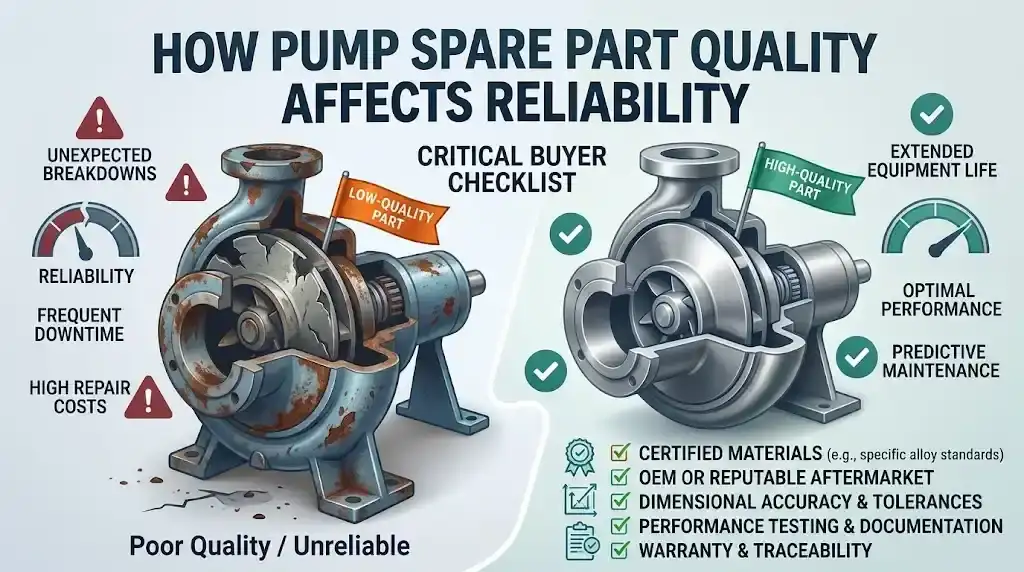
When a pump fails mid-shift, the instinct is to blame the part. And sometimes that’s right. But pump failures rarely come from one cause. The part might be fine, and the real problem is that it was the wrong part for that application, or it was installed incorrectly, or the pump has been running outside its design range for months.
This matters because buyers who focus only on “getting a quality part” can still end up with repeated failures. A well-manufactured impeller made from the wrong alloy will erode in an abrasive slurry application just as fast as a cheap one. A bearing with tight internal tolerances will fail early if the shaft surface finish is rough. The relationship between parts and pump reliability is more specific than most procurement guides suggest.
This article breaks down which part characteristics actually affect pump performance and what B2B buyers should verify before placing an order for pump spare parts.
Before looking at part specifications, it helps to understand the broader failure picture. Pumps fail for a range of reasons, and part quality is one factor among several.
Incorrect part selection is one of the most common causes of premature failure. Ordering by model name alone without cross-referencing the part number, drawing, and dimensions can result in a part that physically fits but runs outside its intended performance range.
Dimensional mismatch causes problems even when the part is otherwise well-manufactured. A shaft sleeve that is 0.1 mm undersized creates enough gap for the seal to leak under pressure. An impeller bore that is slightly off will introduce vibration and uneven bearing loads.
Material incompatibility becomes relevant when the pumped fluid is chemically aggressive. Seals made from NBR (nitrile rubber) are suitable for water and light oils but degrade quickly in contact with certain solvents or acids. Impellers in gray cast iron work fine in clean water but lose material rapidly in mildly abrasive or acidic fluids where ductile iron or hard-metal alloys are required.
Operating outside the pump’s intended range causes failures that no replacement part will fix. Running a centrifugal pump far to the left or right of its best efficiency point (BEP) generates axial and radial forces the bearings and seals were not designed to handle continuously. Parts wear faster, and failures repeat after each replacement.
Cavitation damages impellers from the inside out. When the available NPSH (Net Positive Suction Head) is insufficient, vapor bubbles form and collapse against the impeller surface, causing pitting. Replacing the impeller without addressing the NPSH conditions will produce the same damage again.
Misalignment and improper installation introduce forces that act on shafts, bearings, and seals continuously. Even a good bearing fails early if the shaft is misaligned at installation.
Once you have confirmed you are ordering the right part for the right application, the manufacturing characteristics of that part determine how it performs and how long it lasts. Here is what to look at.
Pump components are manufactured to specific tolerances that control how parts fit together and interact. An impeller hub bore tolerance, a shaft journal diameter, and a seal housing bore, these are not arbitrary numbers. They define the clearances that control fluid leakage, bearing load distribution, and vibration.
A replacement part sourced outside the OEM supply chain needs to match these tolerances, not just the nominal dimensions. A shaft that measures 50 mm in diameter but has a surface deviation of 0.05 mm across the bearing journal will cause the bearing inner ring to seat unevenly, generating fretting corrosion and early fatigue.
Ask the supplier for dimensional inspection reports if you are ordering non-OEM parts in any significant quantity.
Material grade affects strength, corrosion resistance, and wear resistance. For cast iron pump components, the difference between gray iron (GG25), ductile iron (GGG40 or GGG50), and high-chrome alloy iron is significant in abrasive or corrosive applications.
Gray iron is adequate for clean water service. Ductile iron handles moderate impact and corrosion better. For slurry pumps or applications involving abrasive solids, high-chrome white iron (with chromium content typically in the 25-30% range) is specified precisely because its hardness resists the particle erosion that destroys standard grades quickly.
Using a lower-grade material because it fits the physical dimensions is a common procurement error. The part will install without issue and fail in a fraction of the expected service life.
Hardness is the primary indicator of a material’s resistance to abrasion. For impellers handling sandy or gritty fluids, a Brinell hardness (HBW) of 600+ is typically specified for hard-metal alloys. Standard cast iron sits around 180-220 HBW. Installing a standard-grade impeller in an application that calls for a hardened one means the surface erodes far faster than planned.
Shaft surfaces at bearing and seal contact points also require specific hardness levels. A soft shaft surface (below ~55 HRC at seal contact areas) allows the seal face or lip to cut grooves into the shaft, which then creates a leak path even with a brand-new seal installed.
Surface finish on shafts and seal housings is measured in Ra (arithmetic mean roughness), and the specified value depends on the seal type and application. A mechanical seal face requires a very fine surface finish to maintain the fluid film that prevents direct face contact. A lip seal running on a shaft sleeve needs the shaft surface to fall within a specific Ra range, too rough and the seal lip wears prematurely; too smooth and the lubricating film breaks down.
Impeller internal passages and wear ring surfaces also benefit from controlled surface finish to reduce turbulence losses and minimize the rate of erosive wear.
Impellers must be dynamically balanced before installation. An imbalanced impeller generates centrifugal forces that act on the shaft and bearings at the rotational frequency. At 1,500 or 3,000 RPM, even a small mass imbalance creates measurable vibration that accelerates bearing wear. Over time, this also fatigues the shaft and loosens mechanical seal components.
Reputable suppliers provide balancing grade certification (typically to ISO 1940 G6.3 or better for pump impellers). If this documentation is not available, that is a gap worth following up on before installation.
In mechanical seals, the lapped surface of the rotating and stationary faces is where sealing actually happens. The faces are precision-ground and then lapped flat to within a few light bands (optical flatness). Any deviation in flatness creates a leak path that no amount of spring pressure will close.
Replacement mechanical seals from unverified sources sometimes have faces that are ground but not properly lapped, which looks acceptable visually but leaks under pressure. Seal face flatness is difficult to verify without optical equipment, which is one reason seal provenance matters more than it might seem.
Bearings in pump applications are typically selected to an ISO quality grade, and the internal geometry (internal clearance group, raceway finish, cage type) is matched to the operating speed, load, and temperature. A C3 internal clearance group is common for pump bearings operating at elevated temperatures, as it accounts for thermal expansion of the inner ring.
Substituting a bearing with a different internal clearance group, even the same bore and outer diameter, changes how the bearing runs under load. An incorrect clearance group can cause the bearing to preload thermally, generating heat that accelerates grease degradation and leads to early failure.
Seal elastomers, impeller materials, casing liners, and wear plates all need to be chemically compatible with the fluid being pumped. This is not just about corrosion, some elastomers swell in contact with certain fluids, changing seal face contact pressure and causing leaks. Some materials are compatible at ambient temperature but degrade at elevated process temperatures.
For applications involving chemicals, solvents, or treated wastewater, confirm the chemical resistance of seal materials (NBR, EPDM, PTFE, Viton) against the specific fluid. The pump manufacturer’s documentation usually includes a material compatibility chart for common fluids.
For more on how different materials and part types perform in demanding environments, see our detailed guide on pump spare parts in wastewater and sewage systems.
A supplier that manufactures to specification should be able to provide dimensional inspection records, material test certificates (MTC), and hardness test results for the batch. For critical applications, some buyers also request third-party inspection or certificate of conformance documentation.
This is particularly relevant when sourcing cast components like impellers, wear rings, or casing sections, where the casting process can introduce internal porosity or variation in wall thickness that affects both strength and hydraulic performance.
There is a practical case for both OEM and non-OEM parts, depending on the application and the supplier. The mistake is assuming that any aftermarket part described as “equivalent” will perform the same as the OEM part without checking.
OEM parts carry the pump manufacturer’s specification and testing, which means the tolerances, material grades, and surface finishes are aligned with the original design intent. Aftermarket parts can match or exceed these specifications, but the buyer needs to verify, not assume.
When evaluating a non-OEM spare part, the comparison should be against the pump manufacturer’s part drawing or specification sheet, not just the physical dimensions of the worn part being replaced. A worn part is already out of tolerance and makes a poor reference.
The following checklist covers the information needed to order the right part and verify it before installation. Having this information ready also reduces back-and-forth with suppliers and speeds up the ordering process.
Before ordering, confirm:
This information also helps when cross-referencing parts from multiple suppliers. Two parts that share the same nominal dimensions but differ in material grade or internal clearance group are not interchangeable in a high-load or corrosive application.
For a broader look at inspection intervals and maintenance procedures for bearings, seals, and impellers, refer to our pump spare parts maintenance guide.
Impellers, volute casings, wear plates, and diffusers are typically cast components. The casting process, whether sand casting or shell mold casting, introduces variables that affect the finished part’s structural integrity and dimensional consistency.
Porosity in a casting weakens the component and can cause failures under pressure. Variation in wall thickness affects both weight (and therefore balance for rotating parts) and hydraulic performance. Surface finish on internal flow passages after casting affects efficiency.
Foundries that produce cast pump components should maintain consistent metallurgical control over the iron grade, pouring temperature, and cooling rate. Shell mold casting generally produces tighter dimensional tolerances and better surface finish than green sand casting, which is relevant for parts where dimensional accuracy is critical.
Yuyuan Casting produces cast pump spare parts using sand and shell mold casting processes, with material and dimensional checks as part of the production process. Buyers sourcing in volume are welcome to request documentation or discuss specification requirements directly.
Pump reliability depends on more than buying parts from a reputable source. The right material for the fluid, correct tolerances for the fit, appropriate hardness for the wear conditions, and properly lapped seal faces all contribute to how long a part performs before it needs replacing again.
For procurement teams, the most effective approach is to specify parts against the pump manufacturer’s documentation rather than against the worn part being replaced, verify key material and dimensional characteristics with the supplier, and understand which failure mode you are trying to prevent before selecting a replacement part grade or material.
Browse our full range of cast iron pump spare parts or get in touch with our team to discuss your specific application and material requirements.
Exhaust gases are generated by all vehicles. These gases must leave the engine rapidly and in a controlled manner. Th...
READ FULLYour exhaust pipe is straining every other day. It removes hot gases from your engine and helps keep your car running...
READ FULLOEM manufacturers and auto repair shops regularly inspect exhaust pipes. It is not something that you purchase and fo...
READ FULL