



In wastewater and sewage systems, pumps are not “set-and-forget” assets. They operate in abrasive solids, rags, grit, corrosion, and changing flow conditions. That is why spare parts planning is not an administrative task. It is an uptime strategy.
When you carry the right pump spare parts, you shorten outages, reduce emergency labor, and avoid the chain reaction that follows a single pump failure: wet well alarms, bypass pumping, process disruption, permit exposure, and rushed purchasing. When you do not, you lose time in the worst possible way; waiting for parts while the system remains vulnerable.
This article explains, in practical terms, what to stock, how to manage spares, and where spare parts make the biggest difference in real operations.
By the end, you should be able to define a practical spare parts list by pump type and criticality, set a simple stocking structure, and use real-world examples to improve uptime.
What counts as a spare part in this context
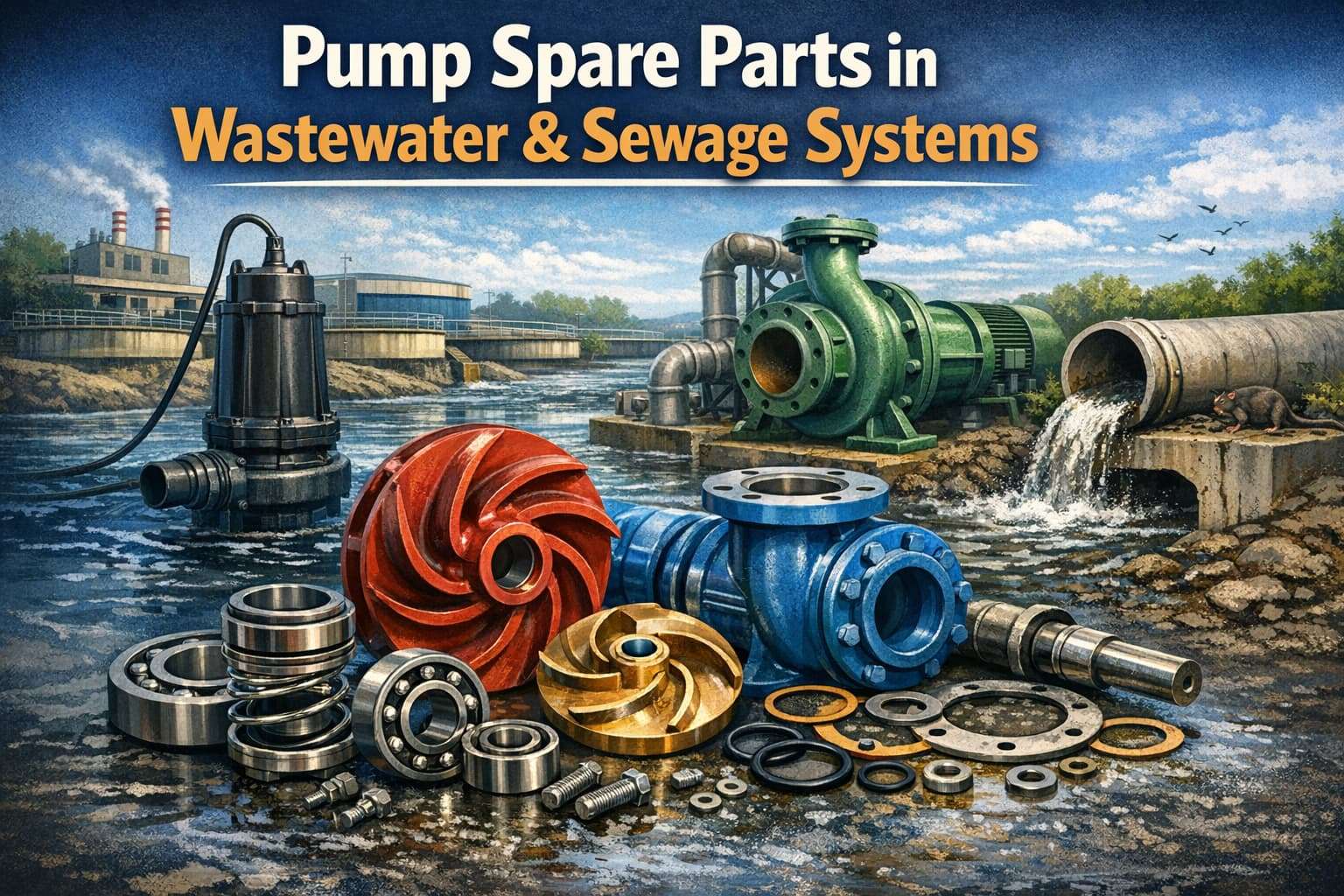
“Pump spare parts” in wastewater typically means the components most likely to wear, leak, clog, or fail in a way that stops service or degrades performance. In practice, that includes mechanical seals, bearings, impellers, wear rings, gaskets, shaft sleeves, cutters, diaphragms, and check valve components—plus the O-rings and fasteners that often decide whether a repair is completed in one visit or two.
Why pump type matters
The pump technologies you use determines the parts inventory mix
Centrifugal pumps (including many dry-pit units) typically drive needs around seals, bearings, wear rings, gaskets, and shaft protection. Submersible wastewater pumps add seal-system and wear-part exposure to solids and fibrous debris. Grinder and macerator pumps create a clear wear pattern around cutters and their associated sealing and bearing components. Positive displacement and sludge-handling designs often push the spare parts focus toward diaphragms, check valves, and elastomers, which can have storage and shelf-life considerations.
This guide stays model-agnostic on purpose. The correct part number still matters, but the decision logic is consistent across brands.
Downtime cost is not just “lost production”
Downtime is the most visible driver. If a pump station cannot maintain level control, you can face overflows, environmental exposure, service complaints, and regulatory consequences. Even when a reportable event is avoided, the cost still appears as overtime, emergency callouts, vacuum truck support, and disrupted schedules across your team.
Lead times create hidden outages
Lead time is the driver many owners underestimate. A seal kit might be available quickly, while an impeller or motor adapter can take weeks. The most common mistake is assuming every part is “a day away” because one common item usually is. One wrong assumption turns a planned half-day repair into a multi-day problem.
Your maintenance strategy should determine your spares strategy
Reactive maintenance forces rush orders and premium freight. Preventive maintenance works best when you standardize kits and parts lists. Predictive maintenance only delivers value when you can act quickly on early warning signs. Reliability-centered thinking helps you decide which spares prevent the most consequence for the least carrying cost.
Typical Pump Configurations in Wastewater and Sewage Systems: What Usually Needs Replacing
Submersible wastewater pumps
Submersible water pumps run on a variety of replaceable parts like mechanical seals, bearings, impellers, wear rings, gaskets, and sometimes shafts or shaft sleeves. Replacing these parts can make the pump functional again. Seals and wear component become worn out or damaged when they are constantly exposed to harsh operating conditions, clogging and abrasion.
Dry-pit centrifugal pumps
These are often easier to access and service, which can reduce downtime. But that can oonly happen if you already have the prts in your inventory. These kind of pumps need spares like gaskets, seals, shaft sleeves, bearings, and wear interfaces. But each part should be compatible with the design of the pump.
Grinder and macerator pumps
These pumps are built for solids, but wear is part of the deal. Cutters or blades, seals, and bearings tend to drive the spare parts plan because cutting performance and sealing integrity keep the station operating.
Vertical turbine and column-style configurations
Where used, these introduce different spares such as column bearings, seals, and motor adapters. The risk is not only failure, but the time required to disassemble if you do not have correct parts on hand.
Sludge pumps and positive displacement pumps
These often shift wear into diaphragms, check valves, seals, and elastomers. The parts may be relatively small and affordable, but they can stop a process just as effectively as a large mechanical failure if they are unavailable at the wrong moment.
Immediate-use spares
These are the sewage pump parts that restore service within a normal maintenance window. They typically include seal kits, common gaskets, and bearings for your most critical pump models. If you stock only one category well, stock this one.
Anticipated-wear spares
These are components that wear at a known rate in your conditions. In wastewater, this often includes wear rings, impellers exposed to grit, cutters in grinder pumps, and elastomers in sludge service. These spares reduce “avoidable emergencies,” where performance declines gradually and then forces urgent work.
Common accessibility spares
These are frequently replaced items used across multiple pump models or stations. This category reduces ordering errors and makes contractor execution more predictable because the same parts appear repeatedly.
Special-order spares
These are long-lead, model-specific items that can extend outages if you wait until failure. Examples can include uncommon impellers, motor adapters, or special components that may not be available in the local market and may need to be imported. No need to use up all your inventory space by stocking every special order spares. Instead judge the most frequent failures and the lead time you can afford and then stock only select items.
The criteria you should set before you buy
For each category, define basic decision criteria: the part’s criticality, the failure mode it addresses, replacement cost, lead time, storage needs, and warranty or specification implications. The common owner mistake is skipping the criteria and letting one bad outage drive all future stocking decisions. That usually creates clutter, not resilience.
Tiered stocking keeps inventory practical
A tiered approach is a strong starting point: essential spares that protect uptime, recommended spares that reduce repeat downtime, and opportunistic spares you purchase when pricing and lead times are favorable.
Map spares to assets, not to general “pump types”
Asset-criticality mapping is where you save time. You link spare parts to specific pumps and stations, then align stock levels to your service expectations. If a station must be restored within hours, its key spares should be on-site or immediately accessible. If restoration can wait a day, central storage may be acceptable.
Reorder points prevent “we used the last one” surprises
Lead-time planning should be explicit. Reorder points and safety stock prevent the situation where you used the last seal kit last month and only discover it during the next outage. Even a simple rule—reorder when you hit one remaining kit for a critical model—reduces risk.
Storage and labeling protect you during emergencies
Moisture, dust, and poor labeling can ruin seals and elastomers or lead to misidentification in an outage. Clear labeling, controlled storage, and a basic check-in/check-out process prevent wasted time and wrong installs.
Case A: Municipal plant standardizes kits for top pump models
A municipal wastewater operation reduced unplanned downtime by focusing on its top three pump models. It standardized seal kits and kept one spare impeller per critical model. The result was faster restoration and fewer emergency orders because the common failure modes could be addressed immediately.
Case B: Industrial facility reduces missed repair windows
An industrial facility repeatedly missed repair windows because procurement began only after a failure. It responded by keeping a small, model-agnostic kit for common sealing needs and ensuring common mechanical seal options were available through a rapid ordering arrangement. The improvement was predictable repair execution, not perfect inventory.
Case C: Pump station improves resilience during peak inflow
A sewer network pump station saw bearing failures and vibration issues spike during peak inflow events. It tied monitoring to spare readiness by keeping quick-access bearings and planning replacements before failure. This avoided catastrophic failures during storm response, when labor and bypass capacity were already strained.
Case D: Submersible pump readiness during storm conditions
In a storm-driven inflow environment, an operator reduced risk by holding wear parts that historically failed under high load and setting up a rapid-access ordering process that worked after hours. The key lesson was timing: parts availability must match real emergencies, not office hours.
Phase 1: Assess what you have
Build a simple inventory of your pumps, capture failure history, and document the spare parts you already own. Most owners find duplicates, missing essentials, and obsolete items at this stage.
Phase 2: Segment by criticality
Classify pumps by criticality and align them to the spare categories. This prevents overstocking low-impact assets while understocking high-impact ones.
Phase 3: Set a basic policy
Set stock levels, reorder points, and supplier criteria. Define who owns the list and who approves exceptions. Lack of ownership is a common reason spare programs fail quietly.
Phase 4: Pilot before you scale
Apply the new stocking approach to a subset of stations or a single facility only. Test how the new stocking approach performs by measuring events like repair time, stock-outs, and emergency orders.
Phase 5: Roll out system-wide
Expand once the process works and the responsibilities are clear.
Phase 6: Review quarterly
Quarterly reviews catch asset changes, obsolescence, and shifting failure patterns before they create delays.
When you are experiencing interruptions because of messy conditions, and uncertain lead times, having a spare parts program gives you the best chance for uptime; you should start by auditing what you currently have, identifying what you need, mapping your spares to your most critical assets, and developing simple reorder guidelines.
A spare parts policy does not have to be complicated; it does have to be well-defined, assigned, and periodically reviewed. This is what makes spare parts into operational resiliency; instead of 'items on a shelf,' they become assets that will protect your operations during their failure.
Exhaust gases are generated by all vehicles. These gases must leave the engine rapidly and in a controlled manner. Th...
READ FULLYour exhaust pipe is straining every other day. It removes hot gases from your engine and helps keep your car running...
READ FULLOEM manufacturers and auto repair shops regularly inspect exhaust pipes. It is not something that you purchase and fo...
READ FULL