




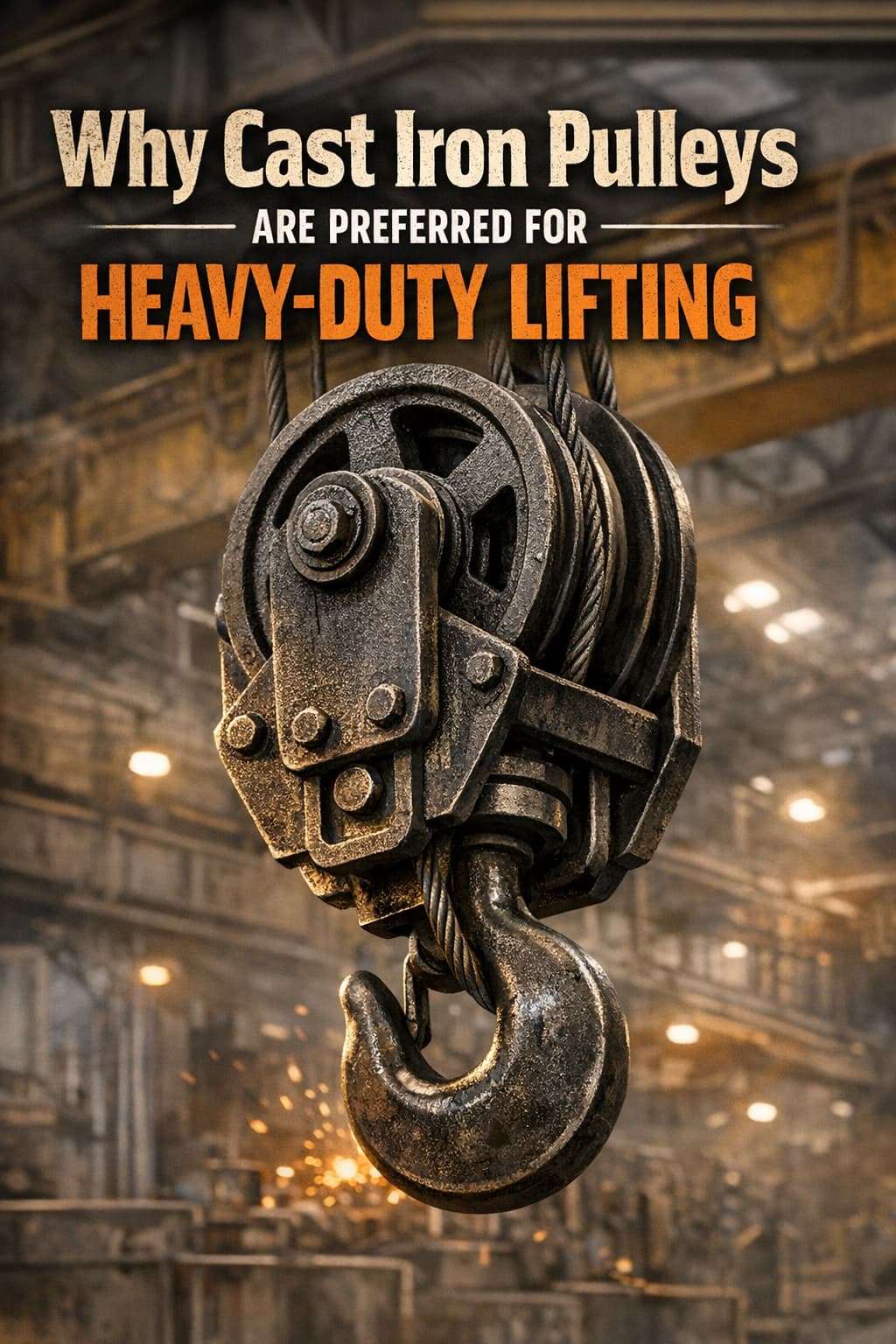
Equipment in industrial settings handling heavy loads must be reliable at all times. A lifting system failure does not simply create downtime. It may lead to severe damage, spoilage, and expensive repairs. All elements of a lifting system must earn their spots, and this is among the most important.
Cast iron has also been the material of choice for heavy-duty lifting applications, such as pulley manufacture. These are well-known and obvious reasons. The cast iron pulley still performs very well in the more challenging industrial environments due to strength, groove design, load capacity, durability, and cost efficiency.
A cast iron pulley is a wheel with a grooved circumference in which ropes, cables, or belts in a lifting or power transmission system are directed and redirected. They are prepared by pouring the melted cast iron into a mold and letting it dry into the required shape. Complex shapes can be cast accurately and consistently.
Cast iron is an alloy of iron and carbon. Cast iron owes its unusual properties of hardness, rigidity, and high compressive strength to the degree of carbon in it. These are the properties that make it especially appropriate for heavy, sustained loads.
Cast iron industrial pulleys are used in cranes, hoists, rigging systems, mining apparatus, marine lifting gear, and myriad other heavy-duty applications worldwide.
The importance of Material Strength in Lifting
The pulley must bear all the tension in the rope or cable passing through it in any lifting system. This tension is colossal under heavy loads. Sustained stress on the pulley should not result in deformation, cracking, or failure. A flexing, warping, or breaking pulley under stress poses an immediate and severe safety hazard.
Cast iron is extremely compressive. It is also much harder to crush or compress than numerous other materials without breaking down at the same cost. When a loaded rope or cable squeaks into the groove of a cast-iron pulley, the material does not bend. This is one of the fundamental reasons why cast iron is used in heavy-duty industrial pulleys.
Stiffness at a constant load
Cast iron is a rigid material. Cast iron does not slip away slowly under constant stress, thereby retaining its shape, unlike some other metals, which creep, as is known. This rigidity is critical in lifting exercises, where a load could be suspended for long periods. Instead of just causing the pulley to creep out of position under sustained load slowly, the entire lifting system would be affected.
This inflexibility also implies that cast-iron pulleys do not lose their exact size with time. The groove geometry remains the same. The bore and hub sizes are correct. Lateral integrity of the overall structure of the pulley is preserved over years of strenuous exercise.
The influence of the Groove on performance.
The groove in a pulley is not merely a channel for the rope or cable to rest on. It is a well-thought-out characteristic that influences the shape of the bend along the rope, the distribution of loads across the rope's cross-section, and the efficiency of force transmission through the lifting system.
The rope has to be placed in a groove that looks good and authentic, thanks to its ideal design. This ensures that the rope is not pinched or flattened, which would wear out easily and could later result in its failure. A groove is cut too deeply into the rope. A groove that is excessively large results in the flattening and loss of structural integrity of the rope when under load.
Cast Iron Permits Accurate Groove Profiles.
One benefit of the casting manufacturing process is the ability to produce accurate, specific groove profiles. The mold determines the shape of a groove, and all pulleys made from the same mold have the same groove shape. This is done to maintain the rope or cable's life and to achieve predictable working behavior across a series of pulleys within the same system.
Cast iron is also easy to machine after casting. Grooves may be finish-machined to tight tolerances when necessary, especially in industrial pulley systems requiring precise alignment for synchronized lifting.
Wear Endurance in the Groove.
A heavily loaded pulley has a groove that undergoes considerable abrasive wear over time. The groove or cable passing under tension slowly wears the sides of the groove. The toughness of cast iron and the presence of graphite make it resistant to wear.
This wear resistance implies that the groove geometry of cast iron pulleys lasts longer than that of softer materials. The groove is maintained in proper shape to safeguard the rope, ensuring consistent performance throughout the pulley's service life.
Dealing with Heavy and Dynamic Loads.
The simplest performance requirement of any industrial pulley is load capacity. In heavy lifting, the load can be both static and dynamic due to acceleration and deceleration forces and sudden changes in the load that the pulley must absorb.
Dynamic loading is more challenging than static loading. If a load is hoisted nearby by a crane, the forces on the pulley can be far in excess of the load itself, except when the load is suddenly checked. The strength and rigidity of cast iron allow it to absorb and transmit these dynamic forces without collapsing.
The mass of a cast-iron pulley and its wall thickness are directly related to the load capacity. Heavier, thicker pulleys carry more weight. With proper casting, pulleys can be made in a range of sizes and wall thicknesses to suit the load demands of various applications.
Safety Margins in Industry Design.
Pulley systems used in industries are always fashioned with a safety factor. This implies that the components will be rated to support loads far in excess of the anticipated working load. Cast iron pulleys are built to suit the desired load ratings, with safety factors taken into consideration.
Using a properly rated cast-iron pulley in the application ensures the system operates safely under anticipated working conditions, including shock loading and infrequent overload.
Working in Unfavorable Conditions.
Workplaces in industries are challenging. There is also typical dust, grit, moisture, exposure to chemicals, and temperature changes, all of which occur in places where heavy lifting takes place. Cast iron would work under such conditions. It is less susceptible to corrosion than mild steel in a variety of environments. It is hard and cannot be destroyed on the surface by abrasive particles. It has a structural property over a broad temperature range.
In the outdoor industry and in environments where the pulley is left to the elements, cast iron is the best choice for its durability, making it worth investing in quality lifting equipment.
Minimal Maintenance requirements.
Cast iron pulleys need comparatively low service. Wear resistance of the material implies that groove surfaces remain in satisfactory conditions over extended periods. The material is rigid; therefore, the progressive deformation does not need to be checked. Occasional inspection of cracking progression, the main mode of failure of cast iron under overload, is simple and can be performed either visually or using simple non-destructive tests.
The cast iron pulleys of heavy-lifting preference do not lie in tradition. It is premised on well-understood material properties that directly respond to industrial lifting requirements. The cast-iron industrial pulley has always been the epitome of heavy-lifting applications.
Exhaust gases are generated by all vehicles. These gases must leave the engine rapidly and in a controlled manner. Th...
READ FULLYour exhaust pipe is straining every other day. It removes hot gases from your engine and helps keep your car running...
READ FULLOEM manufacturers and auto repair shops regularly inspect exhaust pipes. It is not something that you purchase and fo...
READ FULL