




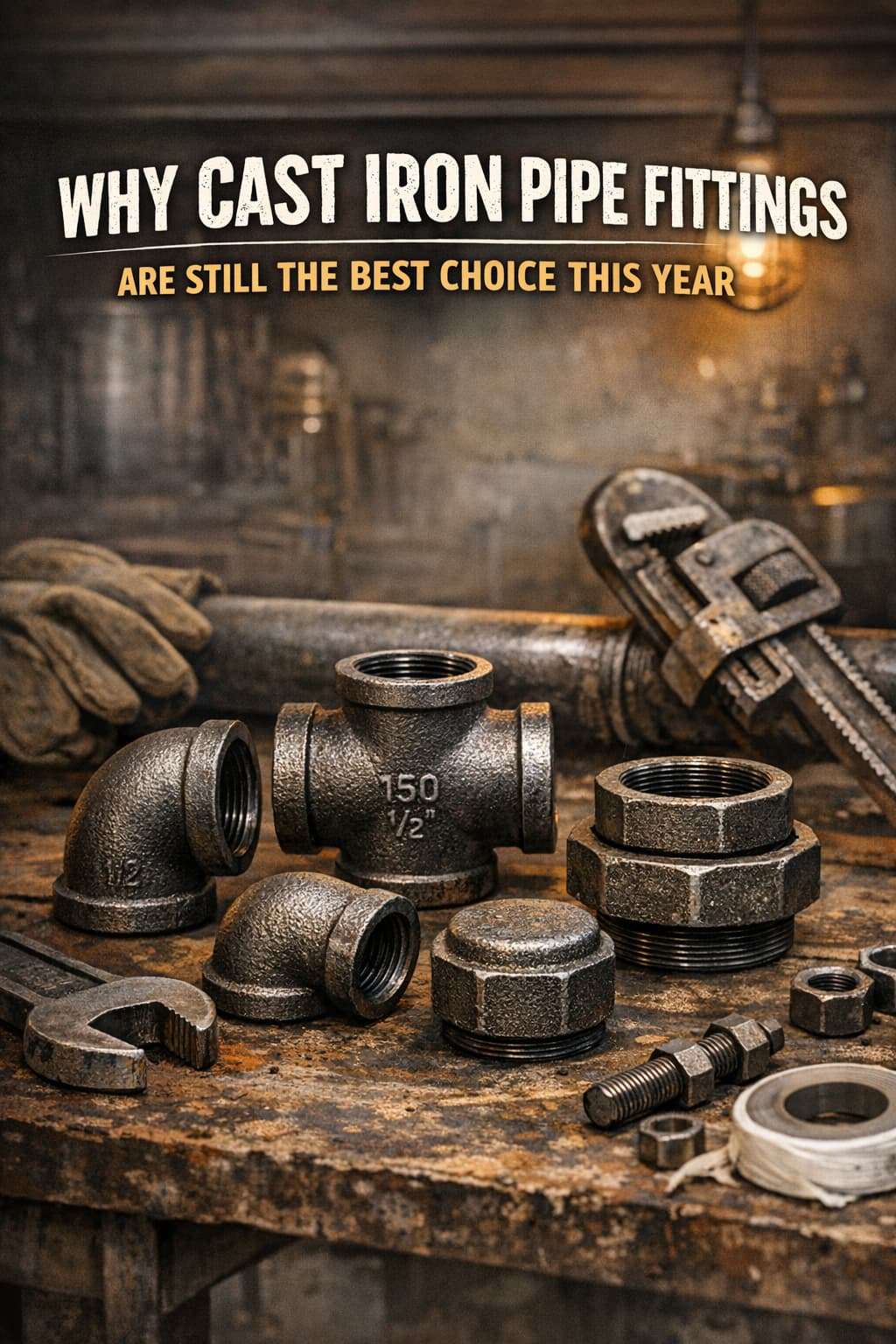
Industrial pipe systems are not built for aesthetic appeal. They are built for peak operational productivity and if that goal is met you are paid in uptime, safety, and predictability. Consequently, the “best” fitting is the one that keeps your facility boring in the best way: fewer leaks, fewer emergency callouts, fewer surprise shutdowns, and fewer debates in the weekly reliability meeting.
Reliability wins. In 2026 cast iron pipe fittings still earn their place in pipe systems worldwide especially in the drainage, waste, vent, and many non-pressure industrial service contexts where cast iron has a long, proven record.
For pipe system owners “best,” rarely means the cheapest line item. It means a material and fitting system that behaves well under real conditions, with real people installing it, maintaining it, and inheriting it after the project team is gone.
So the practical test looks like this: can you source it without drama, install it without heroic effort, and operate it without babysitting? Moreover, can your maintenance team support it with standard tools, familiar procedures, and predictable inspection routines? If yes, you’re buying control; not just parts.
Having control over system performance is what matters in 2026. And that control extends to budget monitoring. Schedules are tight. Labor is stretched. Unless a change clearly reduces risk, most industrial owners prefer the known performer.
In industrial environments, pipe systems don’t live on drawings. They live in mechanical rooms, trenches, risers, and utility corridors where vibration, minor alignment issues, and incidental impacts are normal.
Cast iron pipe fittings tend to tolerate that reality better than many lightweight alternatives. The material’s inherent stiffness and mass help it resist the “small insults” that accumulate over time: a hanger that isn’t perfect, a pump vibration that never quite got tuned out, a pipe chase that gets bumped during unrelated work. Furthermore, that mass helps reduce movement and chatter that can show up as noise, joint stress, or recurring maintenance nuisance. This does not mean cast iron is magic. It means it is steady and reliable. Downtime after all is expensive.
Owners often inherit noise complaints long after a contractor is gone. Vibration complaints too. These are the problems that don’t always break a system, but they do erode confidence and drain time.
Cast iron’s density is a practical asset here. It naturally dampens sound and vibration transmission compared with many lighter piping systems. Additionally, that damping can reduce secondary issues like rattling supports, “ticking” noises, and vibration-driven loosening in adjacent components.
In facilities where pipe runs share space with occupied areas, sensitive equipment, or tight structural constraints, that quieter performance is not a luxury. It’s a risk reducer. The kind you feel in fewer tickets and fewer late-night calls.
Industrial pipe system owners think in consequence, not just likelihood.
Cast iron is noncombustible. That matters in spaces where heat sources exist, where fire separation is part of the facility’s safety story, or where a rare event could carry outsized consequences. Nevertheless, this is not an argument to ignore codes or system design. It’s an argument for choosing materials that simplify the safety posture instead of complicating it. When you are making decisions across an entire portfolio, simple is strategic.
A fitting choice is also a supply chain choice.
Cast iron fittings are broadly standardized and widely supported in common applications. Consequently, sourcing tends to be more predictable across regions and vendors, and replacement parts are less likely to become a special procurement event. Moreover, installers and maintenance teams are often already familiar with the system, which reduces training overhead and the probability of rework due to unfamiliar practices.
This year’s reality is that time is not getting cheaper. Getting the right part on time matters as much as the part itself. Last but not the least, standardization makes your storeroom smarter: fewer oddball SKUs and fewer “we can’t fix it until Thursday” moments.
Most industrial piping work is not greenfield. It is tie-ins, replacements, and staged upgrades around live operations.
Cast iron fittings often fit that retrofit rhythm because they align with long-established practices and common legacy configurations. That compatibility helps in the moments that owners care about most: when you need to isolate a section, make a clean connection, and return to service quickly.
And yes, cast iron is heavier, and handling needs planning. True. But for many owners, that is a known trade: accept a bit more effort at install to buy stability over the long haul.
Pipeline owners want installation simplicity. Project teams are being asked to deliver more with fewer surprises, and the most expensive surprises are schedule-driven. Cast iron’s maturity in the field reduces novelty risk. Fewer unknowns in handling, fewer unknowns in inspection, fewer unknowns in performance. Furthermore, the installed base is enormous, which tends to support continuity in parts availability and contractor familiarity.
Additionally, labor constraints push decision-makers toward systems that require less specialized retraining and fewer second attempts. Consequently, cast iron’s “boring” reputation becomes a feature. You are not buying excitement; you are buying repeatability.
“Isn’t cast iron old-fashioned?”
Old is not the problem. Unmanaged risk is the problem.
Cast iron is established because it works. If your goal is a stable asset that operators can trust, proven materials are often a competitive advantage. Moreover, “new” is not a benefit unless it translates into measurable reductions in failures, maintenance burden, or total lifecycle cost.
“Is it harder to install because it’s heavy?”
It can be. Handling and support planning matter.
But installation difficulty is not just weight; it’s also familiarity, available tools, and crew experience. In many regions and facility types, cast iron installation practices are well understood, which can offset the weight concern through smoother execution and fewer mistakes.
“What about corrosion?”
Corrosion is never a material debate in isolation; it’s an environment debate.
If you have aggressive media, unusual chemistry, or exposure conditions that accelerate corrosion, you address that with proper specification, protective approaches where appropriate, and good system design. Nevertheless, in many standard service environments where cast iron is commonly used, owners see long service life with predictable performance when installation and support are done correctly.
“Aren’t other materials cheaper?”
Sometimes upfront, yes.
But owners pay for outcomes, not invoices. When you factor in replacement cycles, downtime exposure, rework risk, and the cost of emergency response, the “cheap” option can become the expensive one. Consequently, many industrial owners keep returning to cast iron in the places where its strengths align with the system’s real mission.
Cast iron fittings continue to be a strong choice where the priority is stable, low-drama operation. In such systems noise, vibration, and long-term reliability matter a lot. Some prime locations for cast iron pipe fittings are drainage and gravity-flow environments, mechanical spaces near occupied areas, and facilities with extensive retrofit activity where compatibility and compliance is necessary.
Moreover, if your organization values standardization across sites, contractors, and storerooms cast iron supports that operational model. It behaves predictably. It is widely understood. It reduces the number of “special cases” your team has to manage.
Cast iron pipe fittings remain a best-choice contender this year because they support what owners actually need: dependable performance, quieter operation, familiar execution, and a simpler risk profile. Furthermore, they help keep your facility out of the headlines and out of the emergency queue.
Exhaust gases are generated by all vehicles. These gases must leave the engine rapidly and in a controlled manner. Th...
READ FULLYour exhaust pipe is straining every other day. It removes hot gases from your engine and helps keep your car running...
READ FULLOEM manufacturers and auto repair shops regularly inspect exhaust pipes. It is not something that you purchase and fo...
READ FULL