




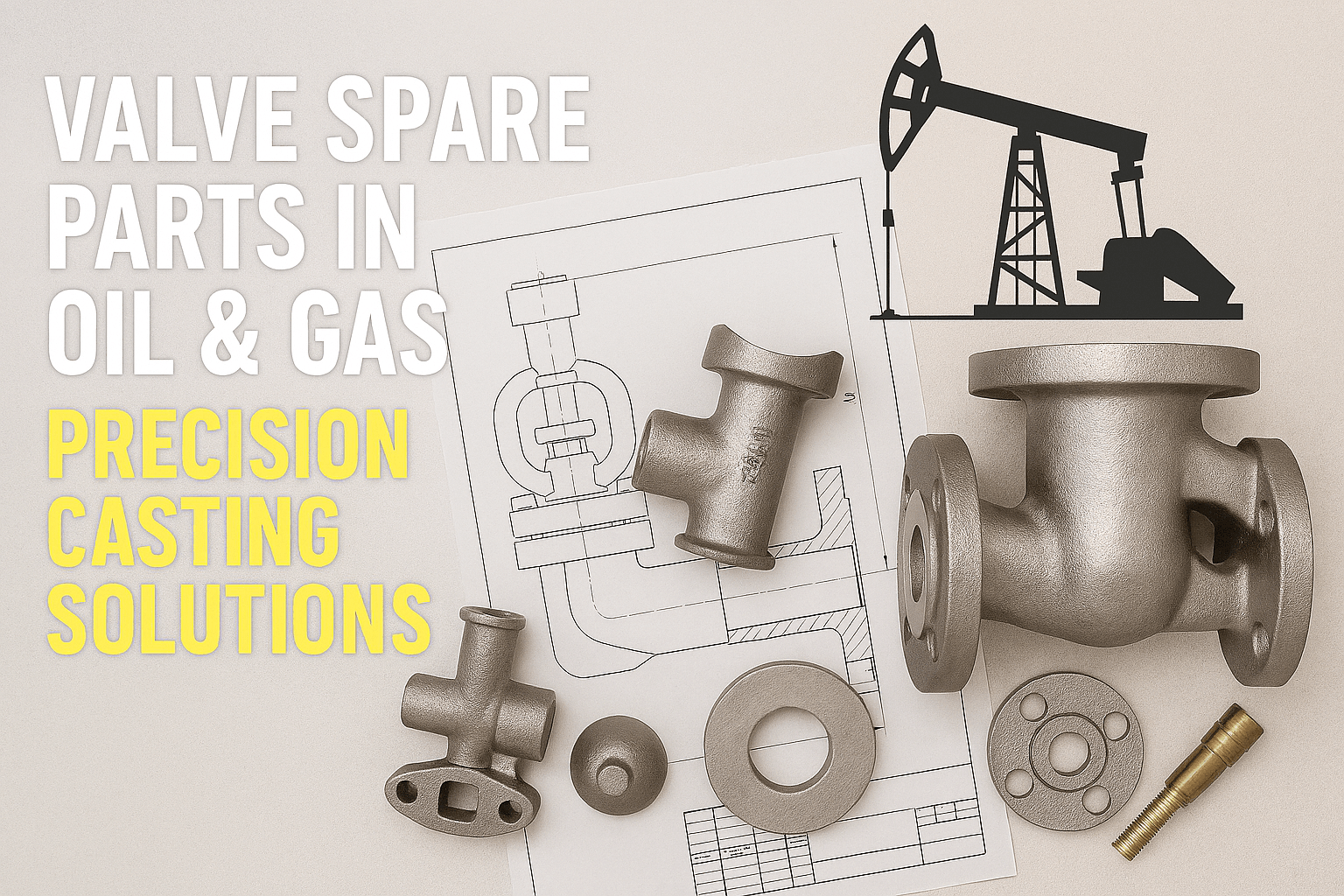
In oil and gas, valves don’t just regulate flow. They protect assets and ensure uptime. Every production line, pipeline corridor, and refining unit depends on one quiet truth: valve spare parts must perform under relentless pressure. Heat. Corrosive media. Cyclic loads. There is no margin for approximation. That’s why procurement teams increasingly scrutinize how valve parts are made, not just how quickly they ship. Precision casting has stepped into this spotlight. Not as a trend but as a necessity.
When engineered correctly, precision-cast industrial valve components deliver tighter tolerances, longer service life, and measurable reductions in unplanned downtime. For buyers responsible for critical infrastructure, this manufacturing approach is highly effective for long term performance of the supply system.
In this blog, we will take a deep dive into how precision casting supports valve parts in oil and gas operations. We will look at where precision-cast valve parts deliver the most impact across upstream, midstream, and downstream operations, and what real-world performance gains look like once these parts are fitted in the system.
Precision casting, often called investment casting, is a casting technique that enables manufacturers to produce complex metal components with a really precise dimensional accuracy. The process involves making wax patterns. These patterns are formed, and coated with ceramic shells, and replaced by molten alloy. The final result is a near-net-shape part requiring minimal machining. But what matters to procurement buyers is the outcome.
Precision casting technique is capable of creating parts with complex geometries that cannot be achieved by simple forging. It creates smoother internal flow paths. Thin walls can be created without compromising strength. Precision-cast parts tend to be highly suited for high performance, unlike parts made from other manufacturing techniques. Most importantly, precision casting produces repeatable quality at scale.
For industrial valve components, this means better sealing surfaces, more consistent wall thickness, and reduced risk of hidden defects. Every micrometer counts. Every interface matters. And when your valves operate in high-pressure or sour service conditions, precision becomes protection.
The oil and gas sector punishes mechanical weakness. Components face erosion from particulates, corrosion from aggressive chemicals, and fatigue from continuous cycling. Precision casting addresses these realities head-on.
High dimensional accuracy improves sealing integrity and reduces leakage risk. Tight tolerances ensure seats align perfectly with discs and balls. This translates directly into lower fugitive emissions and longer maintenance intervals.
Complex geometry capability is another decisive advantage. Flow-optimized cages, integrated ribs, and contoured trim designs can be cast as single pieces rather than assembled from multiple machined parts. Fewer joints. Fewer failure points. Cleaner flow.
Material integrity also improves. Controlled solidification and metallurgical consistency reduces internal stresses and porosity. The result is valve parts that resist cracking, and withstand pressure spikes. Such material integrity guarantees high performance under thermal cycling.
Then there’s cost efficiency. Precision casting minimizes raw material waste and significantly reduces post-processing. Instead of machining away large volumes of expensive alloy, buyers receive near-finished components that require only final touches. Over thousands of parts, the savings compound.
This is why procurement leaders increasingly specify precision-cast valve parts oil and gas applications demand.
Precision casting doesn’t deliver value in theory. It proves itself in the field.
Here’s how it performs across the entire oil and gas lifecycle.
Upstream environments can be tough on the parts. Wellhead assemblies and choke valves are continuously exposed to extreme pressures, abrasive flow, and corrosive fluids which attack simultaneously.
Precision-cast valve seats and stems that are precision casted have the necessary strength required for high-pressure containment while maintaining dimensional stability under fluctuating loads. In sour gas applications, corrosion-resistant alloys produced through precision casting ae able to withstand the chemical degradation for a long time.
An offshore drilling operation experienced frequent seat erosion in choke valves, forcing maintenance shutdowns every few months. After switching to precision-cast alloy seats with optimized flow geometry, maintenance intervals extended by roughly forty percent. Production stabilized. Intervention costs dropped. Operational confidence returned.
Midstream plant layout consists of large-diameter ball valves, gate valves, and actuator assemblies. These systems do not have to tolerate high pressures. Here the pressures fluctuate but remain mid to low. Vibration, and long-distance flow erosion does happen in midstream and they are the main culprit for degradation.
Precision casting produces complex valve internals that improve flow efficiency while maintaining structural integrity. It also allows consistent production of large-volume components with tight tolerances that make fluid transportation extremely reliable.
Let’s consider a scenario in which a pipeline operator struggled with recurring ball valve failures along a long-distance transmission route. Root cause analysis revealed uneven wall thickness from conventional manufacturing. Precision-cast valve balls and internal supports solved the problem by delivering uniform geometry and better stress distribution. Field failures dropped dramatically over the following year.
Downstream pipeline operations introduce new challenges, primarily high temperatures, aggressive chemicals, and constant cycling. Control valves and safety components must maintain accuracy while operating around the clock.
Precision casting shines here. Valve cages and trim produced through precision casting maintain flow control tolerances over extended periods. Smooth internal surfaces reduce turbulence. Consistent metallurgy resists thermal fatigue.
A petrochemical facility faced persistent flow instability due to worn control valve trim. Precision-cast replacements restored accuracy to within tight operational limits and sustained performance for over eighteen months without recalibration. Energy efficiency improved. Product consistency tightened. Maintenance teams finally caught their breath. This is where industrial valve components prove their worth.
Not all casting suppliers are equal. Procurement teams sourcing valve parts oil and gas applications require must look beyond pricing sheets and lead times.
• Start with engineering depth. Can the supplier support alloy selection, flow optimization, and design-for-manufacture? Or are they simply pouring metal?
• Evaluate production controls. Consistent shell building, controlled solidification, and documented inspection processes separate reliable partners from commodity vendors.
• Assess machining integration. Precision casting delivers near-net shapes, but final performance depends on finishing accuracy. Suppliers with in-house CNC capabilities reduce handoffs and variability.
• Scrutinize traceability. Every heat number, every batch record, every inspection report matters in regulated environments.
• And finally, demand application experience. A casting house that understands oil and gas valve requirements will anticipate challenges before they reach your facility.
Let’s bring this home with three concise, illustrative scenarios that mirror real procurement outcomes.
In a refinery struggling with frequent valve seat pop-outs, precision-cast replacements with improved metallurgical consistency reduced failure events by more than fifty percent. Emergency shutdowns declined. Maintenance planning became predictable again.
In a coastal pipeline installation suffering corrosion pitting, high-nickel precision-cast internals extended service life from twelve months to nearly thirty. Replacement cycles stretched. Inventory costs shrank.
In a chemical processing plant battling flow inconsistencies, precision-cast control trim restored accuracy to within tight tolerances, improving throughput while reducing energy consumption. None of these wins required radical redesigns. They required better parts.
Valve spare parts are not commodities in oil and gas. They are operational levers that drive industrial performance and the right combination of parts can supercharge efficiency.
Precision casting offers procurement buyers a powerful way to elevate reliability, control lifecycle costs, and reduce exposure to unplanned downtime. It delivers durable valve parts oil and gas systems depend on. It strengthens industrial valve components at the metallurgical level. And it creates consistency where variability once ruled. This isn’t about chasing the lowest unit price. It’s about engineering resilience into your supply chain. Because when valves fail, operations stall. And when precision leads, performance follows.
If your current valve strategy feels reactive, it may be time to rethink how your parts are made. Precision doesn’t just shape metal. It shapes outcomes.
Exhaust gases are generated by all vehicles. These gases must leave the engine rapidly and in a controlled manner. Th...
READ FULLYour exhaust pipe is straining every other day. It removes hot gases from your engine and helps keep your car running...
READ FULLOEM manufacturers and auto repair shops regularly inspect exhaust pipes. It is not something that you purchase and fo...
READ FULL