




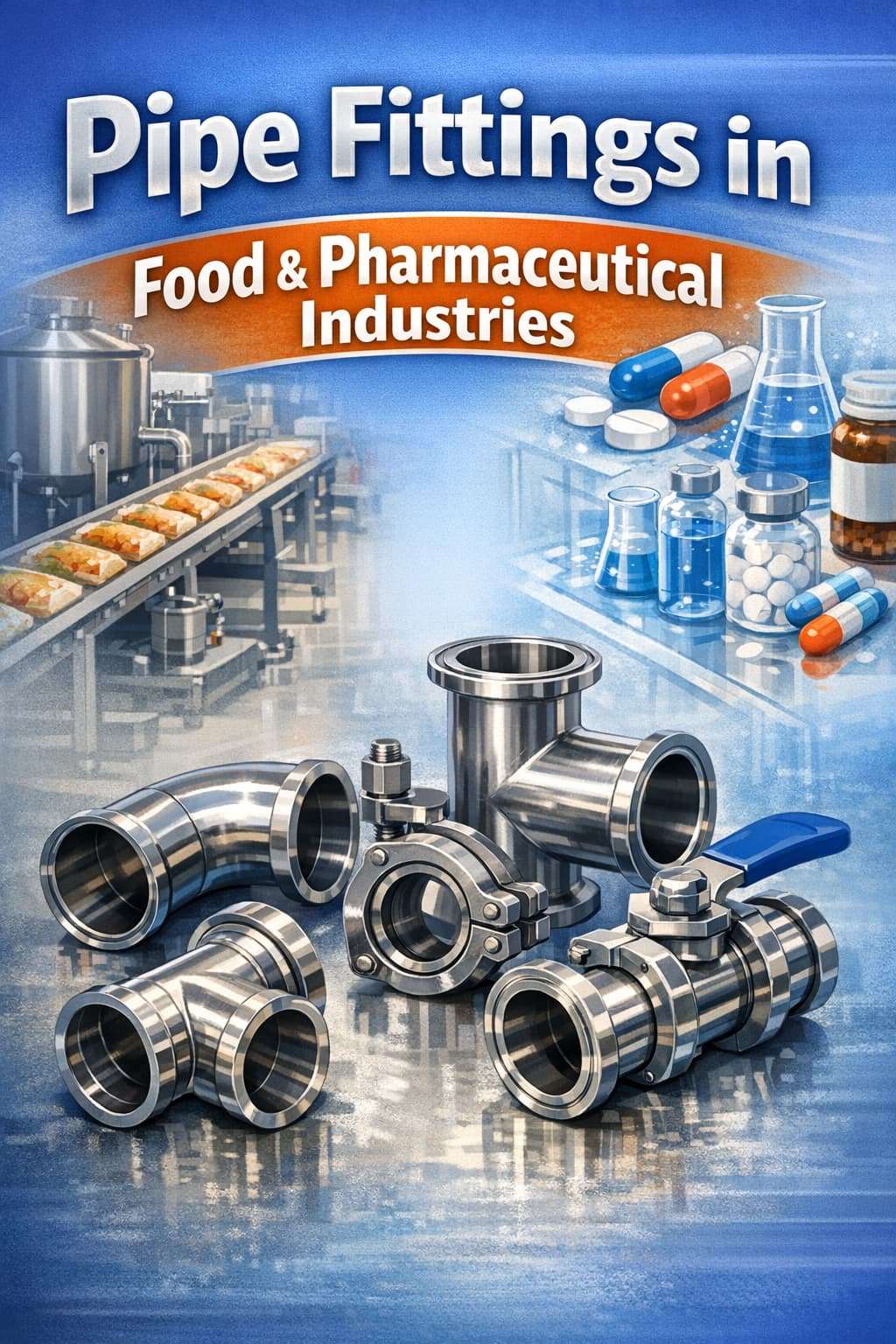
In food and pharmaceutical operations, pipe fittings are never just small components. They are what determines the hygiene and cleanliness of the entire system. And in these industries hygiene is directly related with product quality and, seamless operation of the system. A weak fitting can create contamination risk, cleaning problems, and downtime that spreads far beyond the pipe itself.
That is why procurement teams should treat fittings as a strategic purchase, not a routine line item. The right choice supports compliance. The wrong choice creates hidden cost. And in these industries, the hidden cost is rarely small. In short, clean systems start with clean fittings.
Food and pharmaceutical plants constantly face a compliance pressure of keeping products pure without letting operations get less efficient. That kind of balance is hard to maintain. The right kind of pipe fittings make that possible. They connect lines, control flow, and make system maintenance easy after every operating cycle.
When fittings are poorly selected, residue can build up in joints and corners and moisture can remain trapped. Those are favorable conditions for bacterial growth. Consequently, the system becomes harder to sanitize, harder to maintain, and more vulnerable to contamination events.
Moreover, a poor fitting decision does not only affect product quality. It also reflects negatively on the authenticity of the pharmaceutical brand by affecting brand trust and audit results. One failure can trigger rework, or even a recall. That is a heavy price for a part that may have looked interchangeable at the buying stage.
Industrial buyers should therefore select fittings by considering more than just price. They should evaluate risk, cleanability, material compatibility, and lifecycle value.
What Sanitary Pipe Fittings Do
Sanitary pipe fittings are designed for environments where cleanliness is non-negotiable. They are specially engineered to support hygienic flow, and allow effective cleaning between production cycles. Their internal surfaces are smooth so the risk of buildup is low. Their design avoids crevices. Their joints are made to reduce residue traps.
This matters because food and pharmaceutical products are sensitive to even small contamination risks. A fitting that works in a general industrial line may be completely unsuitable in a hygienic process. The difference is not aesthetic but functional and practical.
Sanitary pipe fittings help plants maintain consistent cleaning performance. They also support the repeatability that regulated industries depend on. When cleaning is predictable, compliance becomes easier to manage.
What Food Grade Pipe Fittings Mean in Practice
Food grade pipe fittings are selected for direct or indirect contact with food processing systems. They are manufactured from non-reactive materials that are suitable for the environment in which they operate. Their operational effectiveness depends on them being corrosion resistant and performing reliably under cleaning and process conditions.
Food grade pipe fittings are not simply “better” fittings. They are fittings matched to a stricter use case. That distinction matters. A fitting may look strong, but if it sheds particles, reacts with process media, or traps residue, it does not belong in a food line.
Additionally, procurement teams should be careful not to assume that “food safe” means universal. Temperature, pressure, cleaning chemicals, and product type all matter. A fitting must suit the system, not just the label.
Stainless Steel as the Core Choice
Stainless steel is the standard choice in most hygienic process systems. It offers strong corrosion resistance, good cleanability, and long service life. For many food and pharmaceutical applications, it is the baseline material, not the premium one.
304 stainless steel is widely used and performs well in many general hygienic environments. This is the perfect material option when temperature and pressure conditions are moderate and the risk of corrosion exposure is also medium. However, in systems where cleaning chemicals are more corrosive or salts are present in fluids a much more robust corrosion resistance is required. Here 316 and 316L often become the better stainless steel variety.
The choice between 304 and 316L should not be taken lightly. It should be based on actual process conditions. Otherwise, a buyer may save a little upfront and pay much more later in replacement and maintenance.
Food-grade Plastics
Some hygienic systems use food-grade plastics such as PTFE or PVC-U, especially in lower-pressure or specialized applications. These can be useful where chemical resistance or weight reduction matters. However, they are not a universal substitute for stainless steel.
Elastomers
Elastomers also matter. Seals and gaskets may not be a major part of the pipeline system but they need to be contaminant-free otherwise, the entire system can become compromised. Hence, seals made from top-quality elastomer like EPDM or silicone is vital for maintaining system purity. made from EPDM or silicone may often play a silent but decisive role in hygiene. That is why buyers should view the full assembly, not only the visible metal parts.
Surface Finish as a Hygiene Issue
Surface finish of pipe fittings is often neglected during purchase but later becomes a major problem for hygiene. In hygienic systems, a smoother internal finish helps reduce product buildup and supports easier cleaning. A rough surface means that the bacteria and residue can get stuck on the surface easily and start to grow. Consequently, buyers should confirm the finish quality early in the sourcing process by looing at the technical specs. A smooth surface finish is the defining feature between a pipe fitting for ordinary system and pipe fittings for a food-grade hygienic system.
Hygienic Clamps and Ferrules
Clamp-style fittings are preferred worldwide because they are easy to assemble and disassemble. This is useful in operations that require frequent cleaning or part replacement, where opening and closing a line quickly can improve maintenance efficiency and reduce downtime.
Ferrules, when properly matched, create secure and hygienic connections. They are especially helpful in systems where cleaning access matters. In fast-moving production environments, that matters a great deal.
Elbows, Tees, and Reducers
These fittings shape the route of flow. Elbows change direction, tees divide or combine flow, and reducers transition between different pipe sizes. In a hygienic environment, their geometry should support smooth movement and avoid dead zones.
Hygienic Valves and Connectors
Valves and connectors are part of the same hygienic setup. They regulate movement, isolate sections, and support operational control. In regulated industries, they must also be easy to clean and easy to verify.
Procurement teams should think about how each connector interacts with the rest of the line. One unsuitable component can undermine the performance of all the others.
Welded and Clamp Connections
Welded connections offer permanence and can reduce joint exposure. Clamp connections offer flexibility and simplify maintenance. The right choice depends on the application, cleaning frequency, and plant strategy.
Unless a system is clearly designed for permanent assembly, many buyers will benefit from using clamp-based solutions in areas that require access. Flexibility has value. So does control.
Regulatory Standards and Certifications
In food and pharmaceutical procurement, compliance is not decoration. It is evidence.
Buyers should expect suppliers to demonstrate adherence to recognized standards such as FDA-related requirements, 3-A sanitary standards, and EHEDG guidance where relevant. These standards matter because they help define what “hygienic” means in practical terms. They also create consistency across facilities and suppliers.
Documentation is equally important. Material test certificates, finish certifications, and batch traceability records help procurement teams support audits and verify that what was ordered is what was delivered. Without documentation, quality claims remain just claims.
This is where serious buyers separate themselves from reactive buyers. Reactive buyers chase product availability. Serious buyers chase proof.
Supporting Clean-In-Place and Sterilize-In-Place Processes
Many food and pharmaceutical systems rely on CIP and SIP methods. That means fittings must support cleaning without requiring full disassembly every time. If the design traps residue or obstructs cleaning fluid, the system becomes harder to sanitize properly.
Therefore, buyers should examine whether fittings allow effective wash coverage. They should also consider whether the design creates dead legs or stagnant zones. A dead leg may seem harmless at first glance. It is not. It can quietly become a contamination point.
Managing Flow Efficiency
Smooth flow is favorable for every kind of pipeline system but its importance for a food or pharmaceutical system cannot be highlighted enough. Poor fitting selection creates turbulence, and unnecessary wear and this brings down the system inefficiency.
Fitting depends on correct sizing and a fitting that is technically compatible may still cause operational strain if the layout is not balanced.
Pipe fittings in food and pharmaceutical industries are small parts with large consequences. They influence hygiene, safety, uptime, and regulatory confidence. For industrial buyers and procurement teams, that means every selection should be deliberate.
Sanitary pipe fittings and food grade pipe fittings are not interchangeable terms to be used loosely. They signal a higher standard of design, material control, and documentation. When buyers understand that distinction, they make better sourcing decisions. When they do not, problems tend to surface later. Usually at the worst time.
The best procurement strategy is simple to state and disciplined to execute. Specify carefully. Verify thoroughly. Source with the whole lifecycle in view.
Exhaust gases are generated by all vehicles. These gases must leave the engine rapidly and in a controlled manner. Th...
READ FULLYour exhaust pipe is straining every other day. It removes hot gases from your engine and helps keep your car running...
READ FULLOEM manufacturers and auto repair shops regularly inspect exhaust pipes. It is not something that you purchase and fo...
READ FULL