




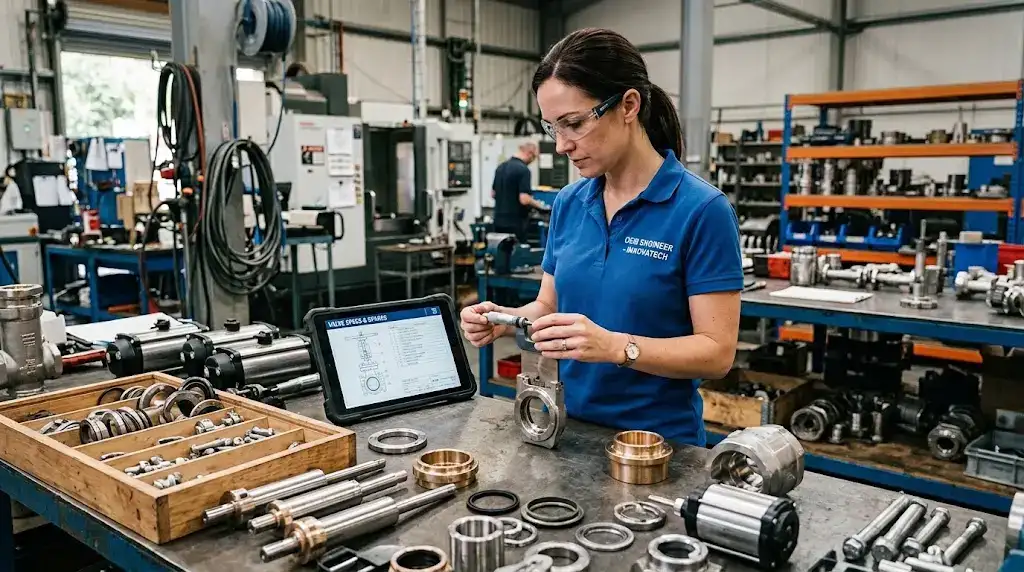
OEM projects require careful planning and expertise to select the correct valve spare parts. There are numerous flow-control valves used in industry. They control water systems, gas systems, chemical systems, and so on, all over the world. Just in case they may require maintenance or repair, the right spare parts make the difference. The delays, safety risks, and waste of money are due to the wrong parts.
OEM valve parts must fit precisely to ensure proper operation. They should be as good as the original equipment. This guide helps buyers select valve spares and covers key aspects, including materials, sizing, and compatibility. Knowing these factors will ensure your OEM project is successful with high-quality, long-life parts.
The first step is to determine the valve type in your system before selecting spare parts. Various valves have different functions. The valves control flow using rotating balls. Gate valves operate on a sliding gate. Valves ensure that nothing flows backward. Globe valves control the flow rate. Butterfly valves are used to provide rapid shut-off in large-diameter applications.
Each valve type has its own spare parts. A ball valve requires a seat, seals, and ball parts. Gate valves need packing materials, stems, and wedges. Knowing your valve type will reduce the number of required parts. It also helps you communicate with suppliers.
Consider the application environment. Industrial scenarios are vastly different from home consumption. Low-pressure systems require different components than high-pressure systems. Extreme temperatures demand special materials. Aggressive materials require durable components. These conditions are known and will help in selecting valve spare parts properly.
• Valve spare parts are critical in material selection. The valve body, stem, and other structural components of a valve are made of metal. A material provides different properties and benefits.
• Stainless steel has high corrosion resistance. It wastes no resources under extreme conditions or in gross fluids. Carbon steel is cheaper in terms of strength. It applies to numerous general purposes. Brass is easy to machine and corrosion-resistant. Bronze is superior to marine works and water systems.
• Match materials with your operational environment. Special alloys or stainless steel are required for exposure to corrosive chemicals. Heat-resistant materials are required for high-temperature applications. Carbon steel could also be used in areas constrained by budget. Serious applications should never be compromised by material quality.
Valve assemblies have seals and gaskets to avoid leakage. These are soft parts made out of various materials other than metal parts. Such common options are rubber, PTFE, graphite, and different elastomers. Material selection depends on temperature, pressure, and fluid type.
PTFE (Teflon) has the ability to withstand high temperatures and a majority of the chemicals. It is quite costly but very dependable. NBR (nitrile rubber) is compatible with oil and fuels. EPDM is applicable in water and steam. Viton is resistant to high temperatures and rough chemicals as compared to ordinary rubber.
Temperature ratings are critical for seals. Normal rubber cannot withstand high temperatures. Graphite is used to pack high temperatures. Look at the specifications of check manufacturers. Incorrect seal material causes leaks and valve failure.
Valve spare parts should be selected with the correct size. The inappropriate sizes do not fit or work. Check on current parts before ordering new ones. Precision during measurements is done using calipers or micrometers. Record all the dimensions such as diameter, length, and thickness.
Valve sizes conform to standard measures. Pipes are utilized with nominal sizes such as 1/2 inch, 1 inch, or 2 inches. These are not necessarily the real dimensions. Knowing the distinction between the nominal size and the actual size. Refer to the documentation on consult valves.
Exceptional focus is needed on thread sizes. Different standards, such as NPT, BSP, and metric, define pipe threads. These are not swap interchangeable. Check thread type, size, and order. Any wrong thread will create leakages and openings.
OEM valve components must be system-pressure and temperature-sensitive. Each component has maximum ratings. Surpassing these limits leads to failures and safety problems. Examine the ratings of pressure classes. The most common classes are 150 and above.
Temperature ratings are dependent on materials and designs. Certain sections operate between - 20 degrees F and 200 degrees F. Others deal with temperatures from -50 °F to 500 °F or higher. Assign your operational conditions to the match ratings. Factors to include: safety margin against sudden spikes of pressure or a temperature change.
Do not assume that all parts of one valve are the same. Seals may be of lower temperature capability than metallic components. O-rings normally fail earlier than metal components. Consider the weakest one in the setting system limits.
• OEM components of valves are from the original manufacturers. They are fully compliant with specifications and quality. Third-party suppliers deliver aftermarket parts. They may or may not be true to the original requirements.
• The compatibility and performance of OEM parts are guaranteed. They are more expensive, yet they provide peace of mind. The Aftermarket parts may be cost-effective. The quality of suppliers, however, varies widely. There are aftermarket parts that are of the same quality as OEM. Others fail and bring about trouble.
• OEM parts tend to justify the additional expense for critical applications. In other, less serious applications, aftermarket components can do the job. Carefully researched aftermarket supplier. Check clearances and certifications. Request materials, certifications, and test reports.
• Valve spare parts are selected by part number. Manufacturers assign a unique number to each component. The correct part numbers ensure exact replacements. Whenever possible, record the part numbers of in-stock parts.
• Components are normally stamped or printed with part numbers. Valve nameplates list compatible part numbers. Part numbers are also looked up in manufacturer catalogs. Record part numbers for future use.
• Some components apply to multiple valves. General parts save inventory requirements. Make sure that it is compatible. Similarity does not necessarily mean that the part fits. Check the part numbers; they always fit your specific valve model.
When working on OEM projects, the appropriate valve spares should be selected based on several factors. Understanding valve types and their uses guides the initial selection.
Exhaust gases are generated by all vehicles. These gases must leave the engine rapidly and in a controlled manner. Th...
READ FULLYour exhaust pipe is straining every other day. It removes hot gases from your engine and helps keep your car running...
READ FULLOEM manufacturers and auto repair shops regularly inspect exhaust pipes. It is not something that you purchase and fo...
READ FULL