




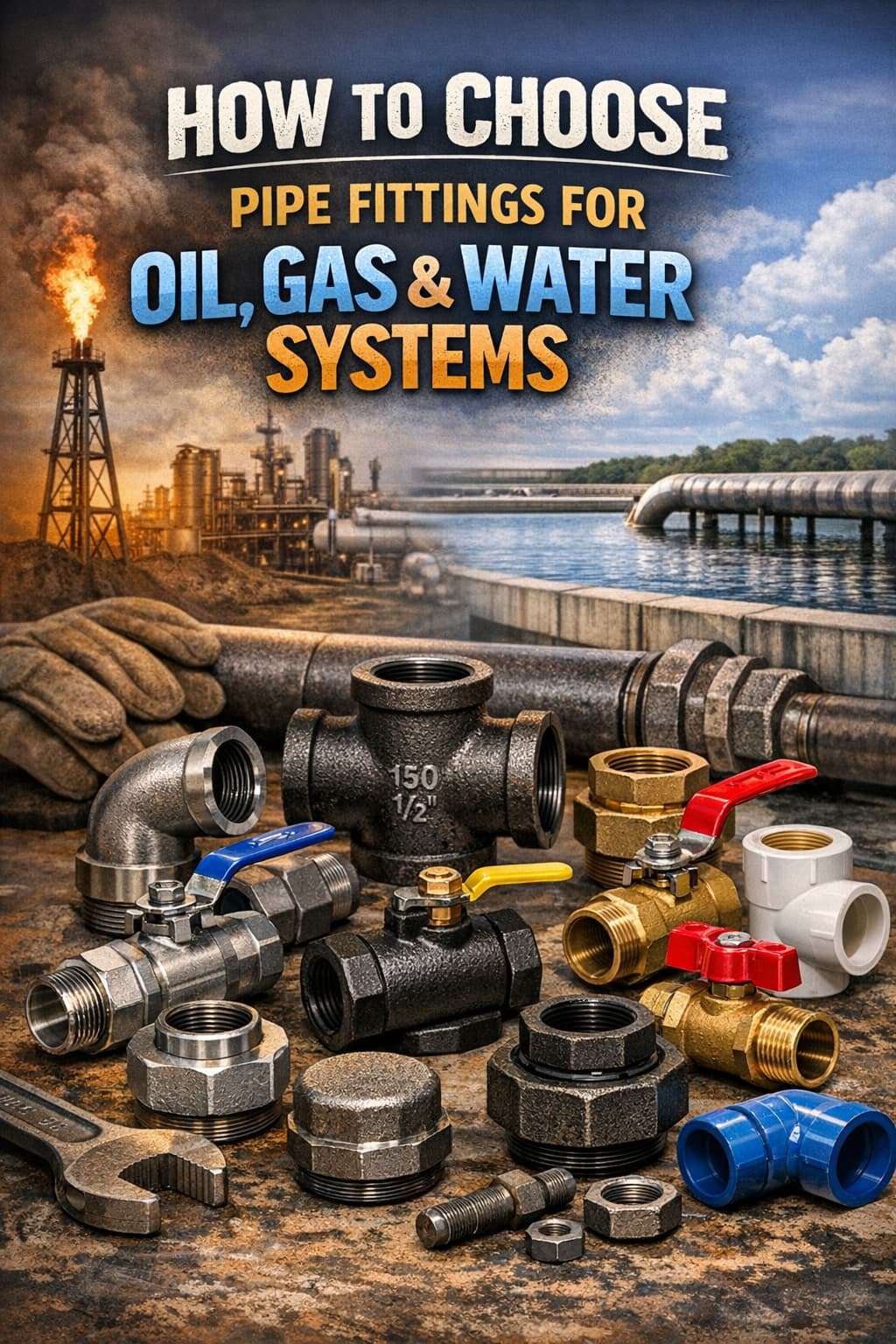
Pipe fittings are tiny yet crucial elements in a piping system. They connect piping, reverse flow, divide lines into new ones, and enable portions of the piping to be joined and removed where necessary. Regardless of the material the system is in, oil, gas, or water, the correct choice of fittings can have a critical difference in whether the system will be safe, efficient, or leak, fail, or cause serious problems.
Fitting the incorrect one, even a similar one to the proper one, may result in pressure failures, corrosion, contamination, and time loss, all of which are costly. This guide provides the main information on fitting types, their purposes, and the process of selecting fittings that best suit oil and gas and water systems.
The Stakes Are High
A fitting failure may leak oil and gas systems, leading to fire hazards, environmental damage, and fines. The improperly fitted material in a water system may lead to corrosion, contamination, or loss of pressure. Not every fitting in a system will be without responsibility. It is always cheaper to avoid failures than to incur them later by ensuring the selection is initially correct.
One Size Does Not Fit All
Various systems make use of various pressures, temperatures, and fluids. What fits very well in a low-pressure water line will entirely fail in a high-pressure gas system. The materials' compatibility, pressure capacity, and connection type should also meet the application-specific requirements. The first task needed is knowledge of the fundamentals of fitting types.
Elbows
The most commonly used fittings in any piping system are elbows. They cause a change of flow direction. The 90 degrees and 45 degrees are the most prevalent. The elbow turns at a sharp angle of 90 degrees. The elbow positioned at a 45-degree angle produces a gentler transition.
Pipes require elbows wherever there is a need to bend around an obstacle, due to the structure of a building, or to turn in a system. In oil and gas pipelines, long-radius elbows are frequently used. They permit the fluid to deviate more slowly. This minimizes turbulence and pressure drops in the system.
Elbows with short radius are applied where there is limited space. However, they are more turbulent and should not be used in high-velocity or abrasive applications. The type of elbow that will be selected is based on the space available, the flow nature, and the pressure demands of the system.
Tees
A tee fitting separates one pipe into two or combines two pipes into one. It is shaped like the letter T. The central pipe is laid directly through the fitting. Off the middle, a branch connection is set at a 90-degree angle.
Tees are also important in any distribution that requires flow to be distributed among a variety of outlets. They can be used in water supply systems to feed multiple branches from a single main line. They enable the division or addition of flow in junction points in oil and gas systems.
Equal tees are not different in diameter at all connections. The branch connection is lower than that of small-run tees. The right decision depends on the size of the pipes in question and the volume to be handled at that crossroad.
Couplings
The couplings are used to connect 2 pipes of the same diameter. These are plain basic fittings. They are, however, necessary during the extension of pipeline paths, the repair of damaged parts, and the joining of pipes produced by an alternative source.
A standard type of coupling is a straight sleeve, which links two pipe ends. The reducing coupling joins two pipes with varying diameters. A branch connection is made to an existing pipe using half couplings. Repair couplings are designed to repair broken or damaged sections of the pipe without necessarily cutting and replacing a large portion of the pipe.
Couplings are also among the most commonly sold wholesale pipe fittings in systems where pipes must be joined quickly during installation.
Reducers
Reducers connect pipes of different diameters. They are applied when there should be a transition of flow between large and small pipes or the other way round. Concentric reducers leave the pipes' centerlines identical. Eccentric reducers compensate for the off-centerline. Eccentric reducers are especially handy in horizontal pipe runs where liquid drainage is a concern.
Unions
Unions resemble couplings, but they differ in one aspect. They can be detached without cutting the pipe. A union is made up of three components that enable unscrewing of the fitting and separation of the pipes on demand. This necessitates the use of unions in a system that requires scheduled maintenance, inspections, or component replacements.
Caps and Plugs
The end of the pipe is capped and plugged. Caps are attached to the ends of a pipe. Plugs fit inside. They both can close off parts of a system, sometimes temporarily or permanently. They are frequently applied in the installation, testing, and maintenance.
Carbon Steel
In the oil and gas systems, carbon steel fittings are common. They are good at high pressure and high temperature. They are robust, long-lasting, and come in a large variety of sizes and configurations. Unless coated or treated, they do not suit well for water systems where corrosion is an issue.
Stainless-Steel
Stainless steel fittings are very resistant to corrosion. They find application in water systems, chemical processing, and food-grade applications. They are more expensive than carbon steel but provide longer service life in corrosive environments.
Brass
Water and gas systems, fittings with brass are widely used in residential and commercial buildings. They are non-corrosive, easy to handle, and can withstand moderate pressure. They do not work well under high pressure in the industry.
PVC and CPVC
Low-pressure water systems involve plastic fittings. PVC can be used in cold water. CPVC can work with temperature and is applied in hot water systems. Plastic fittings are lightweight, low-priced, yet not oil or gas-resistant or high-pressure.
Pressure Rating
All fittings are provided with a pressure rating. The fitting cannot exceed the system's maximum operating pressure. Fitting an underrated component in a high-pressure system is hazardous. Never buy fittings without verifying their pressure class, particularly when buying wholesale pipe fittings for large projects.
Temperature Range
High temperatures influence both metals and plastics. There are maximum temperature limits for each fitting material. Fittings should be chosen in high-temperature systems, either in steam, hot oil, or high-temperature gas mode, to be able to work with the operating temperature without degrading.
Connection Type
There are several ways fittings are attached to pipes. The fittings have threads and screw on the end of a pipe. Socket weld fittings are also welded. Butt weld fittings are permanently and end-to-end welded high-strength fittings. Flanged fittings use bolted flanges for connections that may need to be removed. The type of right connection would depend on the pressure, the joint's use, and the need to remove the joint.
Fluid Compatibility
Fluids have various interactions with materials. Certain metals corrode in the presence of some chemicals. Some plastics degrade in the presence of certain oils. The fitting material should be able to carry the fluid it is designed for, or be fully compatible with it. This is particularly critical in oil and chemical systems, where the wrong choice in terms of material may cause rapid degradation.
Wholesale purchasing of pipe fittings benefits project management, buyers, and contractors in a very straightforward manner. The unit cost is also low because of bulk buying. It maintains the uniformity of quality of all fittings in a project. It also eliminates waiting before small reorders lead to delays.
When purchasing wholesale pipe fittings, it is essential to ensure that one does business with a supplier who can provide certifications for the materials they use and the pressure ratings of their products. Fitting approved fittings would be accompanied by documentation to demonstrate compliance with the pertinent industry requirements. It is imperative in oil, gas, industrial water, and other forms of water systems where compliance is required.
The selection of the appropriate pipe fittings is not a small matter. It is a very important choice that determines the safety, efficiency, and life of any piping system. Knowledge of the role played by elbows, tees, couplings, reducers, and other types of fittings is the basis of a sound choice of fittings in the pipes.
Exhaust gases are generated by all vehicles. These gases must leave the engine rapidly and in a controlled manner. Th...
READ FULLYour exhaust pipe is straining every other day. It removes hot gases from your engine and helps keep your car running...
READ FULLOEM manufacturers and auto repair shops regularly inspect exhaust pipes. It is not something that you purchase and fo...
READ FULL